


guillermo_lucero
Project OwnerSenior PM leading strategy, architecture alignment, and cross-team coordination. Oversees milestones, governance integration, and ecosystem alignment to deliver a secure development stack on time.
DEEP Connects Bold Ideas to Real World Change and build a better future together.
Coming Soon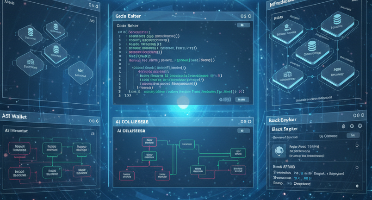

We propose building a model-agnostic, AI-native IDE and programmable development infrastructure for ASI:Chain that enables structured agent and contract generation, enforced validation checkpoints, local simulation, and safe deployment to DevNet and Testnet. A vendor-neutral AI Model Abstraction Layer and programmable Dev API Gateway ensure reproducible builds, secure wallet-controlled transactions, and governance-aware lifecycle tracking—delivering not just tooling, but stable builder infrastructure aligned with MainNet V1.
This RFP seeks proposals for the development of an AI-native Development Environment (IDE) that improves the efficiency and accessibility of blockchain application development for the ASI:Chain.

In order to protect this proposal from being copied, all details are hidden until the end of the submission period. Please come back later to see all details.
Timeline: Weeks 1–4 / The first month establishes the architectural and AI-governance foundation of the ASI:Chain AI-Native DevKit. The objective is to formalize a strict separation between generative AI output and executable blockchain artifacts before introducing chain interaction complexity. This milestone ensures structural clarity provider neutrality and schema-enforced generation as the core discipline of the system. The focus is stability before functionality. By the end of this milestone the AI Model Abstraction Layer will govern how structured artifacts are produced versioned and validated against ASI:Chain primitives.
Complete layered architecture documentation - AI Model Abstraction Layer (initial implementation): - Provider adapter interface (model-agnostic design) - Versioned structured prompt contract framework - Typed ASI:Chain output schema definitions - Structural artifact materialization pipeline Regression validation framework for provider stability Public modular repository scaffold
$12,000 USD
Success is achieved when generated artifacts strictly conform to typed ASI:Chain schemas through the abstraction layer, independent of provider selection. The architecture must be documented and versioned, and structured outputs must produce consistent artifacts from identical inputs. This confirms that generation is formally governed prior to blockchain execution.
Timeline: Weeks 5–8 / The second month operationalizes the validated AI outputs by introducing programmable chain interaction. This milestone implements the ASI-Chain Dev API Gateway and connects structured artifacts to a Docker-based DevNet environment through a TypeScript SDK. The objective is to demonstrate controlled compilation and deployment to DevNet without manual chain interaction. This transforms the system from architectural framework into programmable infrastructure.
Dev API Gateway implementation: - Contract compilation endpoint - Agent deployment endpoint - DevNet network switch endpoint Core TypeScript SDK integrated with DevNet Docker-based local DevNet lifecycle management: - Start / Stop / Reset controls Structured compilation → deployment pipeline Versioned API documentation
$14,000 USD
Success is achieved when structured artifacts validated through the abstraction layer can be compiled and deployed to DevNet through the SDK and API Gateway without manual chain interaction. API endpoints must be versioned, DevNet must operate reliably, and deployment must be reproducible.
Timeline: Weeks 9–13 / The third phase delivers the functional AI-native development environment. This is the most engineering-intensive milestone integrating the abstraction layer Dev API Gateway wallet controls simulation enforcement and explorer visibility into a unified IDE workflow. Developers will be able to generate structured contracts and agents validate them through enforced checkpoints simulate execution locally and deploy to DevNet within a controlled lifecycle. This milestone transforms infrastructure into a tangible builder experience.
AI-native IDE interface (alpha release) Integrated structured generation pipeline: - Generation - Schema validation - Artifact materialization - Compilation - Simulation Non-custodial wallet integration: - Keplr and Leap support - Transaction preview - Gas simulation - Explicit signing flow Integrated DevNet explorer panels: - Blocks - Transactions - Deployed contracts CLI integration with Dev API Gateway Local DevNet lifecycle controls inside IDE
$17,000 USD
Success is achieved when developers can complete the full controlled workflow: Generate > Validate > Simulate > Deploy to DevNet. Invalid artifacts must be blocked before deployment eligibility, wallet transactions must require preview and confirmation, and the integrated explorer must accurately reflect on-chain state. A live end-to-end demonstration confirms operational readiness.
Weeks 14–16 / The final phase embeds governance signaling and economic accountability into the builder lifecycle while enabling Testnet readiness. This milestone integrates ERC-8004 review submission token burn mechanisms lifecycle traceability and network switching to Testnet. The objective is to demonstrate a complete MainNet-aligned builder lifecycle that connects generation deployment execution review and economic signaling.
ERC-8004 review submission interface On-chain review verification Token burn integration: - Burn trigger endpoint - Explorer burn visibility Testnet network switching support Lifecycle tracking across: - Generation - Deployment - Review - Burn Full documentation set: - Architecture overview - Developer onboarding guide - Demo repository Public end-to-end workflow demo
$7,000 USD
Success is achieved when a complete lifecycle flow can be demonstrated: Generate > Validate > Deploy > Execute > Submit Review > Burn > Verify on Testnet. Governance actions must be verifiable on-chain, Testnet migration must occur without refactor, and documentation must enable reproducible deployment by third parties.
 Reviews & Ratings
Please create account or login to write a review and rate.
Check back later by refreshing the page.
© 2026 DEEP Funding





Join the Discussion (0)
Please create account or login to post comments.