


priya.iciness534
Project OwnerProject leadership, package architecture, registry design.
DEEP Connects Bold Ideas to Real World Change and build a better future together.
Coming Soon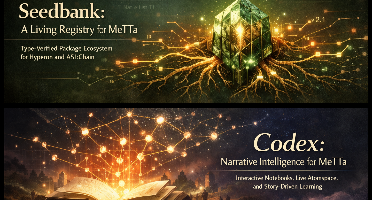

I have mass-deleted node_modules 847 times in my career. I know because I wrote a shell alias to count. The JavaScript ecosystem taught us that package management without type guarantees is a slow-motion disaster. Cargo showed us it can be better, but even Cargo can't prevent semver violations at the type level. MeTTa changes this equation entirely. Because Hyperon's type system can verify that an Atomspace subgraph is well-typed before publication, Seedbank can guarantee something no existing registry can: every package version is type-compatible with its declared dependencies. Not by convention. By proof. Seedbank treats packages as living organisms in a typed ecosystem.
This RFP seeks proposals for the development of an AI-native Development Environment (IDE) that improves the efficiency and accessibility of blockchain application development for the ASI:Chain.

In order to protect this proposal from being copied, all details are hidden until the end of the submission period. Please come back later to see all details.
Project initiation for MeTTa package manager. Architecture whitepaper covering package format Atomspace-based registry Hyperon verification pipeline dependency resolution on-chain governance. Survey cargo/npm/pip architectures and adapt for dependent types. Design package manifest format with MeTTa type exports. Evaluate DAS 1.0 for distributed registry storage. Connect to BlockDAG DevNet for governance contracts. Define 15 seed packages across 3 categories. Hiring plan budget risks. Budget: Personnel 3900 (65%). Infrastructure 1200 (20%: DevNet DAS). Review 600 (10%). Docs 300 (5%). De-risks M2-M4 by validating package format and dependency resolution approach.
D1. Architecture Whitepaper (20+ pages): Package format registry design verification pipeline dependency resolver governance contracts. D2. Package Manager Survey: cargo/npm/pip analysis with adaptation plan for MeTTa dependent types. D3. Package Manifest Spec: Format definition with type exports dependency declarations metadata. D4. DAS 1.0 Evaluation: Distributed registry storage assessment. D5. DevNet Connection: Governance contract deployment proof. D6. Seed Package Specs: 15 packages across core/contracts/AI categories. D7. Hiring Plan & Budget: Per-week allocation risk register. D8. Dev Environment: CI/CD setup <30 min.
$6,000 USD
SC1. Architecture reviewed by 2+ community reviewers. SC2. Package format reviewed and approved by 3+ MeTTa developers. SC3. DAS 1.0 confirmed viable for distributed registry. SC4. DevNet governance contract deployed successfully. SC5. 15 seed package specs approved. SC6. Budget covers 100% of $50K with weekly granularity. SC7. CI/CD passing, setup <30 min.
Build CLI tool (init install publish test search) Atomspace-based registry with DAS 1.0 storage and Hyperon verification pipeline. CLI handles full package lifecycle. Registry stores packages as Atomspace subgraphs with content-addressed storage. Every publish triggers Hyperon type checking — packages accepted only if well-typed. Semantic version detection through type signature comparison. 15 seed packages published: 5 core 5 contracts 5 AI modules. Budget: Personnel 11700 (65%). Infrastructure 3600 (20%: DAS Singularity Compute). Testing 1800 (10%). Docs 900 (5%). Risk: Verification speed → Singularity Compute offload. Registry scale → start local migrate to DAS.
D1. CLI Tool: metta init install publish test search audit. Cross-platform. D2. Registry: Atomspace-based with DAS 1.0 storage. Content-addressed packages. D3. Verification Pipeline: Hyperon type checking on every publish. Rejection of ill-typed packages. D4. Semantic Versioning: Automatic version detection via type signature comparison. D5. Seed Packages (15): 5 core libraries 5 contract templates 5 AI modules. All verified. D6. Dependency Resolver: Constraint-based resolution with type compatibility. D7. 250+ tests CI pipeline 85%+ coverage.
$18,000 USD
SC1. CLI handles full lifecycle for all 15 seed packages. SC2. Registry stores and retrieves packages correctly. Semantic search works. SC3. Verification pipeline rejects 100% of ill-typed packages in test suite. SC4. Semantic versioning correctly detects breaking/non-breaking changes for 10+ test cases. SC5. Dependency resolution handles 3-level dependency chains. SC6. 3+ developers publish packages using the CLI. SC7. 250+ tests pass, 85%+ coverage.
On-chain governance via Rholang contracts on BlockDAG DevNet. Package naming disputes maintainer transitions governed by CBC Casper consensus. Singularity Compute integration for heavy verification and complex dependency resolution. Atomspace-aware semantic dependencies — specify needs by capability not name. Conflict detection at type level with adapter suggestions via concept blending. Security audit integration. Lockfile generation for reproducible builds. Budget: Personnel 10400 (65%). Infrastructure 3200 (20%: Singularity Compute DevNet). Testing 1600 (10%). Docs 800 (5%). Risk: Governance complexity → start with naming only. Semantic deps → fallback to name-based.
D1. Governance Contracts: Package naming disputes maintainer transitions on BlockDAG. CBC Casper finalized. D2. Singularity Compute: Heavy verification offload. Complex dependency resolution. 3x+ speedup. D3. Semantic Dependencies: Atomspace queries for capability-based package discovery. D4. Conflict Detection: Type-level incompatibility detection with adapter suggestions. D5. Security Audit: Integration with vulnerability databases. 'metta audit' command. D6. Lockfiles: Reproducible builds with content-addressed lockfiles.
$16,000 USD
SC1. Governance contracts handle 5+ naming/dispute scenarios correctly. SC2. Singularity Compute reduces verification time 3x+ for large packages. SC3. Semantic dependencies resolve correctly for 5+ capability queries. SC4. Conflict detection identifies 90%+ of type incompatibilities in test suite. SC5. Lockfiles produce reproducible builds for all 15 seed packages. SC6. Security audit detects known vulnerabilities in test packages.
10-developer beta testing full package management workflow. Community package contribution program. Documentation: user guide package authoring guide governance guide. Shell completions. Open source MIT release to SingularityNET registry. Project website with package browser. Community engagement and marketing. Budget: Personnel 6500 (65%). Infrastructure 2000 (20%: hosting). Testing 1000 (10%: beta). Docs/Marketing 500 (5%). Risk: Beta recruitment → leverage 200+ star community. Package quality → verification ensures baseline.
D1. Beta Program: 10 developers use full workflow. Recorded sessions NPS scoring. D2. Community Packages: 5+ external developers publish packages. D3. Documentation: User guide authoring guide governance guide API reference. D4. Shell Completions: bash zsh fish PowerShell. D5. Open Source: MIT SingularityNET registry. Install <30 min. D6. Package Browser: Web UI for exploring published packages. D7. Website & Marketing: Landing page tutorials community links.
$6,000 USD
SC1. 8+ of 10 beta developers complete publish/install workflow in 4 hours. NPS 7+. SC2. 5+ community packages published and verified. SC3. 25+ total packages in registry. SC4. Package browser correctly displays all packages with type signatures. SC5. 50+ GitHub stars in 30 days. SC6. MIT licensed, documented, 85%+ coverage.
 Reviews & Ratings
Please create account or login to write a review and rate.
Check back later by refreshing the page.
© 2026 DEEP Funding


Join the Discussion (0)
Please create account or login to post comments.