


Eventmesh
Project OwnerProject leadership, LSP architecture, Hyperon inference integration (completion + verification), Atomspace project model design. PR #847 to Hyperon type inference. Weekly check-ins.
DEEP Connects Bold Ideas to Real World Change and build a better future together.
Coming Soon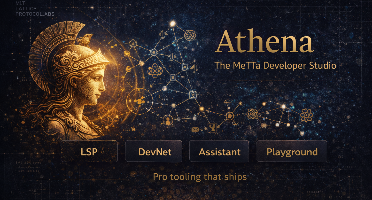

The ASI ecosystem deserves developer tooling that matches the sophistication of the language itself. Athena is a studio environment — like Unity or Android Studio, but for MeTTa — where every capability shares a single source of intelligence: Hyperon inference over a unified Atomspace project model. LSP architecture means it works with your existing editor. MCP protocol means AI agents are development partners, not sidekicks. Time-travel debugging shows relationship evolution, not just variable changes. Continuous verification runs in the background, proving properties as you type. The result: an environment that teaches MeTTa while you build with it.
This RFP seeks proposals for the development of an AI-native Development Environment (IDE) that improves the efficiency and accessibility of blockchain application development for the ASI:Chain.
Design the unified architecture and build the foundation: Atomspace project model and LSP server core. Define how MeTTa source maps to Atomspace atoms, how incremental parsing updates the graph, and how all LSP operations dispatch to Hyperon inference. Prototype: LSP server that provides go-to-definition and hover via Atomspace queries for 5 MeTTa files. Design MCP protocol extensions for AI agent access. Survey LSP implementations, time-travel debuggers, and continuous verification systems. Benchmark MORK/PeTTa incremental parsing latency. Budget: Personnel $3,900 (65%). Infrastructure $1,200 (20%: Atomspace, MORK/PeTTa). Review $600 (10%). Docs $300 (5%). De-risks M2-M4 by validating that Atomspace project model supports all planned LSP operations with acceptable latency.
Design the unified architecture and build the foundation: Atomspace project model and LSP server core. Define how MeTTa source maps to Atomspace atoms, how incremental parsing updates the graph, and how all LSP operations dispatch to Hyperon inference. Prototype: LSP server that provides go-to-definition and hover via Atomspace queries for 5 MeTTa files. Design MCP protocol extensions for AI agent access. Survey LSP implementations, time-travel debuggers, and continuous verification systems. Benchmark MORK/PeTTa incremental parsing latency. Budget: Personnel $3,900 (65%). Infrastructure $1,200 (20%: Atomspace, MORK/PeTTa). Review $600 (10%). Docs $300 (5%). De-risks M2-M4 by validating that Atomspace project model supports all planned LSP operations with acceptable latency.
$8,000 USD
SC1. LSP prototype provides correct go-to-definition for 95%+ of symbols in 5 test projects. SC2. Atomspace incremental update completes in <100ms for typical edits. SC3. Architecture supports all planned capabilities (verified by design review). SC4. Architecture reviewed by 2+ community members. SC5. Budget covers 100% of $50K. SC6. CI/CD passing, setup <30 min.
Build the two most impactful LSP capabilities: Hyperon-powered completions and semantic error diagnostics. Completions: backward chaining over type context, pattern constructor enumeration, Atomspace query pattern suggestions, Singularity Compute for expensive proof searches. Diagnostics: forward chaining causal error explanation, clickable error chains, dependent type proof obligation display, closest-valid-alternative suggestions. Type inference via Hyperon: infer types for unannotated expressions, display inferred types on hover. Rholang awareness: channel type completions, process type diagnostics. Budget: Personnel $11,700 (65%). Infrastructure $3,600 (20%: Singularity Compute, Atomspace). Testing $1,800 (10%). Docs $900 (5%). Risk: Completion latency -> async streaming + Singularity Compute offload. Type inference depth -> configurable search limits.
D1. Completion Engine: Hyperon backward chaining completions with type ranking. D2. Diagnostic Engine: Forward chaining causal error explanation with clickable chains. D3. Type Inference: Inferred types displayed on hover for unannotated expressions. D4. Singularity Compute: Async proof search offload for complex completions. D5. Rholang Support: Channel and process type completions and diagnostics. D6. Editor Packages: VS Code extension + Neovim plugin using LSP. D7. 250+ tests, CI pipeline, 85%+ coverage.
$18,000 USD
SC1. Completions include the correct term in top-5 for 80%+ of type-constrained positions. SC2. Error diagnostics provide correct causal chain for 85%+ of type errors. SC3. Completion latency <200ms for 90%+ of requests (excluding Singularity Compute async). SC4. Type inference matches manual annotations for 90%+ of test expressions. SC5. 3+ developers use Athena as primary editor for a MeTTa project. SC6. 250+ tests pass, 85%+ coverage.
Add time-travel debugging and continuous verification layers to the same environment. Debugger: Atomspace snapshot capture at each reduction step, forward/backward stepping, relationship change visualization, Rholang channel state inspection. Verification: background Hyperon proof search for annotated properties, green/yellow/red status indicators, counterexample generation on failure, cache invalidation via Atomspace dependency tracking. Rholang safety: deadlock detection, channel linearity checking, resource bound verification. CBC Casper: finality requirement encoding as type constraints. BlockDAG: concurrent execution pattern detection. Budget: Personnel $10,400 (65%). Infrastructure $3,200 (20%: Singularity Compute, DevNet). Testing $1,600 (10%). Docs $800 (5%). Risk: Snapshot overhead -> structural sharing + configurable granularity. Verification timeout -> bounded proof search + incremental caching.
Add time-travel debugging and continuous verification layers to the same environment. Debugger: Atomspace snapshot capture at each reduction step, forward/backward stepping, relationship change visualization, Rholang channel state inspection. Verification: background Hyperon proof search for annotated properties, green/yellow/red status indicators, counterexample generation on failure, cache invalidation via Atomspace dependency tracking. Rholang safety: deadlock detection, channel linearity checking, resource bound verification. CBC Casper: finality requirement encoding as type constraints. BlockDAG: concurrent execution pattern detection. Budget: Personnel $10,400 (65%). Infrastructure $3,200 (20%: Singularity Compute, DevNet). Testing $1,600 (10%). Docs $800 (5%). Risk: Snapshot overhead -> structural sharing + configurable granularity. Verification timeout -> bounded proof search + incremental caching.
$14,000 USD
SC1. Debugger correctly captures and replays 95%+ of reduction steps for test programs. SC2. Verifier discharges 80%+ of properties for correctly annotated programs. SC3. Counterexamples found for 90%+ of intentionally violated properties. SC4. Rholang safety checker detects 85%+ of known deadlock patterns. SC5. Snapshot overhead <15% of execution time for typical programs. SC6. CBC Casper type constraints prevent premature deployment in 100% of test cases.
Complete the environment with semantic code review and AI agent integration, then launch beta. Semantic diff: Atomspace-level change analysis, affected caller tracking, review comments attached to atoms. MCP integration: AI agents query project model, run verification, propose changes through standard protocol. 15-developer beta program across MeTTa and Rholang projects. Documentation: getting started, capability reference, MCP agent development guide. Open source MIT release. Budget: Personnel $6,500 (65%). Infrastructure $2,000 (20%: hosting, DevNet). Testing $1,000 (10%: beta). Docs/Marketing $500 (5%). Risk: Adoption -> LSP-based (works in their existing editor, zero editor migration).
D1. Semantic Code Review: Atomspace diff with affected caller tracking. D2. MCP Agent Integration: AI agents access full project model and capabilities. D3. Beta Program: 15 developers using Athena on real MeTTa/Rholang projects. NPS. D4. Documentation: Getting started, capability reference, MCP agent guide. D5. Open Source: MIT licensed, SingularityNET registry. D6. Demo: Full lifecycle — write, complete, debug, verify, review — in one integrated session.
$5,000 USD
SC1. 12+ of 15 beta developers adopt Athena as primary MeTTa environment. NPS 7+. SC2. Semantic diff correctly identifies affected callers for 90%+ of type-changing commits. SC3. MCP agents successfully query project model and run verification. SC4. 75+ GitHub stars in 30 days. SC5. MIT licensed, 85%+ coverage. SC6. Demo shows write-complete-debug-verify-review in one session without switching tools.
 Reviews & Ratings
Please create account or login to write a review and rate.
Check back later by refreshing the page.
© 2026 DEEP Funding


Join the Discussion (0)
Please create account or login to post comments.