


Emilyvas
Project OwnerProject leadership and architecture. Designs the type-directed MeTTa-to-Rholang pipeline and Hyperon inference integration. Ensures neural-symbolic coherence across components.
DEEP Connects Bold Ideas to Real World Change and build a better future together.
Coming Soon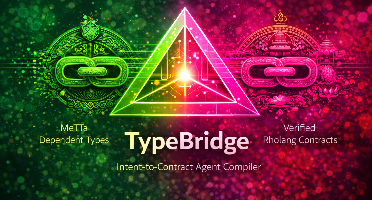

We compile MeTTa type specs into verified Rholang contracts. Input: agent behavior as MeTTa dependent types. Processing: type-directed generation with Hyperon verification. Output: Rholang contracts proven correct before deployment. This isn't LLM code generation — it's formal synthesis where types guarantee correctness. M1 delivers the compilation pipeline with 15+ verified templates. M2 adds a 2-5 agent simulation arena for interaction testing. M3 completes lifecycle tooling and runs a DevNet beta with external developers. We're type-theory people applying compiler techniques to agent development.
This RFP seeks proposals for the development of an AI-native Development Environment (IDE) that improves the efficiency and accessibility of blockchain application development for the ASI:Chain.
Milestone 1 delivers the core type-directed compilation pipeline transforming MeTTa dependent type specifications into verified Rholang smart contracts. The pipeline operates over the Atomspace using Hyperon inference to verify that generated Rholang satisfies behavioral constraints encoded in MeTTa types. This milestone focuses exclusively on compilation infrastructure and the template library — no simulation no deployment tooling. The template library provides 15+ verified MeTTa-to-Rholang patterns in three categories: token operations (transfer mint burn approve with balance invariants) oracle interactions (query callback timeout with liveness guarantees) and multi-party protocols (escrow atomic swap voting with safety properties). Each template pairs a MeTTa type specification with a verified Rholang implementation and Hyperon-checkable correctness proof. The type-directed generator accepts composed MeTTa specifications and produces Rholang through systematic type-driven selection of contract fragments. Hyperon inference validates each composition step. The generator handles Rholang-specific concerns including name channel management process spawning and CBC Casper-compatible state management on the BlockDAG.
1. MeTTa Intent Specification Framework: Atomspace library providing dependent types for agent behavioral specification with parameterized types for financial operations communication patterns and state machines. Full documentation with examples. 2. Verified Template Library (15+ templates): MeTTa-to-Rholang pairs covering token operations (5+) oracle interactions (4+) and multi-party protocols (6+). Each includes type spec Rholang implementation Hyperon-verifiable correctness properties and composition rules. 3. Type-Directed Rholang Generator: Compilation engine transforming composed MeTTa intent specs into Rholang contracts via type-directed synthesis. Handles template composition name channel allocation process generation and BlockDAG-compatible state patterns. 4. Hyperon Verification Integration: Pre-generation type checking and post-generation correctness verification via Hyperon inference. Reports detailing which properties hold and which need manual review. 5. Developer Documentation: Step-by-step guide for specifying intents in MeTTa types composing templates generating Rholang and interpreting verification results.
$8,000 USD
1. Pipeline Completeness: Generator compiles 15+ distinct MeTTa intent specs into valid Rholang contracts across all three template categories (token, oracle, multi-party). 2. Correctness Rate: Hyperon inference confirms behavioral correctness for 90%+ of generated contracts using library templates. Remainder produces clear diagnostics. 3. Composition Depth: Generator handles 3-level template compositions (e.g., escrow wrapping token transfer wrapping oracle query) with preserved correctness at each level. 4. Error Detection: Pipeline rejects 95%+ of intentionally malformed MeTTa specs (type errors, unsatisfiable constraints, incompatible compositions) with actionable messages. 5. Usability: 3+ developers unfamiliar with the system produce a verified Rholang contract from MeTTa spec within 2 hours in structured evaluation. 6. Performance: Pipeline completes within 60s for single-template specs and 5min for 3-level compositions.
Milestone 2 delivers a scoped multi-agent simulation where 2-5 agents from MeTTa type specs interact through simulated Rholang channels within the Atomspace. The arena validates behavioral correctness of agent compositions from the M1 pipeline catching interaction-level bugs that per-agent type checking misses. The arena operates entirely within the Atomspace — all simulation state is accessible to Hyperon inference. Agent interactions follow Rholang's formal operational semantics allowing Hyperon to reason about multi-agent properties (deadlock freedom liveness fairness) during simulation. Scope is deliberately constrained: deterministic execution 2-5 agents sequential message delivery fixed interaction scenarios. No adversarial testing or concurrent scheduling. This ensures tractability while validating critical multi-agent properties. The simulation produces trace logs in the Atomspace recording every state transition and channel communication. Developers query traces using MeTTa. Singularity Compute stub interfaces prepare for distributed simulation.
1. Simulation Engine: Atomspace-native engine instantiating agents from MeTTa type specs executing Rholang channel interactions via formal process reduction. Supports 2-5 agents with sequential delivery and deterministic execution. 2. Scenario Library (8+ scenarios): Bilateral exchange multi-party escrow oracle arbitration token auction voting protocol timeout recovery cascading transitions governance proposals. 3. Hyperon Property Checker: Runtime verification during simulation checking deadlock freedom channel liveness balance conservation protocol completion. Generates violation reports with Atomspace trace references. 4. Trace Analysis Toolkit: MeTTa query interface for simulation traces. Temporal queries (before/after event X) causal queries (what caused state Y) property queries (when was invariant Z violated). Visual sequence diagrams. 5. Simulation CLI/API: Command-line and programmatic interface for running simulations configuring scenarios extracting results. Integrated with M1 pipeline for seamless specify-generate-simulate workflow.
$28,000 USD
1. Scenario Coverage: All 8 scenarios execute successfully with M1-generated agents, producing correct traces verified by Hyperon property checking. 2. Detection Accuracy: Property checker identifies 90%+ of intentionally injected violations (deadlocks, balance errors, protocol deviations) across 20+ faulty configurations. 3. Trace Queries: MeTTa queries return results within 5s for simulations of 5 agents and 100 steps. All query types functional. 4. Pipeline Integration: End-to-end from MeTTa spec through generation through simulation completes without manual intervention for template-based compositions. 5. Scalability: Engine handles 5 agents with 200 steps without memory exhaustion or timeout (under 10min). Performance documented. 6. Validation: 5+ developers (2+ external) use the arena to identify and fix a multi-agent behavioral bug in structured evaluation.
Milestone 3 completes TypeBridge with lifecycle management DevNet deployment and a beta program. This transforms M1-M2 infrastructure into an end-to-end experience: specify in MeTTa generate verified Rholang simulate interactions deploy to DevNet monitor behavior. Lifecycle management: versioning of MeTTa specs with semantic diff tracking upgrade paths preserving Hyperon-verified invariants monitoring mapping on-chain events to MeTTa specs rollback leveraging Rholang's formal model for safe BlockDAG state transitions. DevNet integration: one-command deployment with pre-deployment Hyperon verification against actual DevNet state. Post-deployment monitoring connects on-chain events to the Atomspace for MeTTa-queryable live analysis. Beta program: 10-20 external developers build and deploy agents. Feedback drives documentation template expansion and feature prioritization. Singularity Compute validated through beta workloads.
1. Lifecycle Manager: Version control for MeTTa specs with semantic diffing (behavioral changes not text). Upgrade planner with Hyperon-verified safety. Rollback with formal guarantees. 2. DevNet Pipeline: One-command deployment from MeTTa spec to live contract. Pre-deployment Hyperon verification. CBC Casper-compatible transaction construction. Gas estimation for generated Rholang. 3. Monitoring: Dashboard mapping BlockDAG events to MeTTa behavioral specs. Real-time Hyperon property monitoring. Alerts for behavioral deviations. MeTTa query interface for live analysis. 4. Beta Program: Onboarding for 10-20 developers. Tutorial series for full workflow. Weekly office hours. Issue and feedback documentation. 5. Open Source Release: MIT-licensed release of all components. SingularityNET registry publication. Community template contributions. API docs and developer guide.
$4,000 USD
1. DevNet Success: 10+ agent contracts from the pipeline deployed to DevNet executing correctly for 7+ days without violations. 2. Lifecycle: Semantic diff identifies behavioral changes in 90%+ of spec updates. 3+ upgrades on DevNet with Hyperon-verified safety. 3. Monitoring: 95%+ on-chain events correctly mapped to MeTTa specs. Alerts within 60s of detected deviations. 4. Beta Participation: 10+ external developers complete the full workflow. NPS 7+ from participants. 5. Community: Template library grows to 25+ (including contributions). 5+ participants contribute a template or docs improvement. 6. Release: All code MIT-licensed with passing CI, comprehensive docs, 80%+ test coverage on core components.
 Reviews & Ratings
Please create account or login to write a review and rate.
Check back later by refreshing the page.
© 2026 DEEP Funding


Join the Discussion (0)
Please create account or login to post comments.