


Ashley
Project OwnerArchitect for five CLI tools, shared Atomspace engine, Unix pipe composition. Designs tool interfaces, Atomspace schema, cross-tool integration. Rust implementation and cross-platform distribution.
DEEP Connects Bold Ideas to Real World Change and build a better future together.
Coming Soon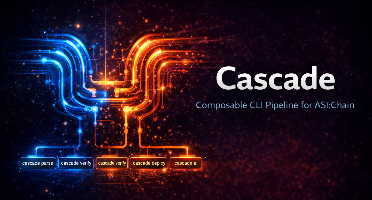

Cascade delivers five composable CLI tools for Rholang and MeTTa where AI uses Hyperon inference over Atomspace, not LLM prediction. Each tool does one thing: parse (AST), verify (MeTTa dependent types), deploy (BlockDAG DevNet with CBC Casper), test (property-based), ai (Hyperon-inferred generation). Tools compose via pipes: 'cascade parse | cascade verify | cascade deploy'. The only CLI where AI suggestions are logically guaranteed through type-directed synthesis, not statistically likely. Developer patterns feed Atomspace, creating self-extending intelligence.
This RFP seeks proposals for the development of an AI-native Development Environment (IDE) that improves the efficiency and accessibility of blockchain application development for the ASI:Chain.
Build the foundational two CLI tools (cascade parse and cascade verify) plus the shared Atomspace engine that powers all five tools. The parse tool converts Rholang and MeTTa source files into structured AST representations while simultaneously ingesting them into Atomspace as typed atoms with semantic relationships. It handles the full grammar of both languages including Rholang's process algebra constructs and MeTTa's pattern matching and grounded atoms. The verify tool performs formal verification using MeTTa's own dependent type system powered by Hyperon backward-chaining inference over the Atomspace code graph. For Rholang, it encodes behavioral types as MeTTa types and checks channel protocol conformance. For MeTTa, it leverages native dependent type inference. Failed verifications produce proof traces showing exactly which inference step failed. The shared Atomspace engine manages the knowledge base that accumulates semantic information across all tool invocations, with persistent storage and efficient query interfaces. Both tools follow Unix conventions: stdin/stdout, JSON structured output, composable via pipes. This milestone establishes the inference-first architecture that distinguishes Cascade from every existing blockchain CLI toolkit.
Build the foundational two CLI tools (cascade parse and cascade verify) plus the shared Atomspace engine that powers all five tools. The parse tool converts Rholang and MeTTa source files into structured AST representations while simultaneously ingesting them into Atomspace as typed atoms with semantic relationships. It handles the full grammar of both languages including Rholang's process algebra constructs and MeTTa's pattern matching and grounded atoms. The verify tool performs formal verification using MeTTa's own dependent type system powered by Hyperon backward-chaining inference over the Atomspace code graph. For Rholang, it encodes behavioral types as MeTTa types and checks channel protocol conformance. For MeTTa, it leverages native dependent type inference. Failed verifications produce proof traces showing exactly which inference step failed. The shared Atomspace engine manages the knowledge base that accumulates semantic information across all tool invocations, with persistent storage and efficient query interfaces. Both tools follow Unix conventions: stdin/stdout, JSON structured output, composable via pipes. This milestone establishes the inference-first architecture that distinguishes Cascade from every existing blockchain CLI toolkit.
$9,000 USD
1. cascade parse correctly parses 100% of the Rholang and MeTTa test corpus (50+ files each) including edge cases like nested new bindings, complex pattern matches, and higher-order channel passing. 2. cascade verify detects at least 90% of injected type errors in a test corpus of intentionally flawed contracts, with proof traces correctly identifying the failing inference step in 85%+ of cases. 3. Pipe composition 'parse | verify' processes a 50-file project in under 10 seconds on standard hardware. 4. Atomspace correctly accumulates semantic relationships across multiple parse invocations, with query response times under 100ms for graphs up to 10,000 atoms. 5. Both tools install as single binaries on Windows, macOS, and Linux without runtime dependencies. 6. All 250+ test cases pass in CI. 7. Three independent developers successfully use the tools on their existing Rholang/MeTTa projects without assistance.
Deliver the Hyperon inference-powered AI coding tool (cascade ai) and the BlockDAG deployment tool (cascade deploy) with CBC Casper finality monitoring. The ai tool is the centerpiece of Cascade: it performs type-directed synthesis using Hyperon backward chaining to generate code where every expression is a logical consequence of the specification. It supports four modes: generate (new code from spec), transform (semantics-preserving refactoring), optimize (performance improvement with behavioral equivalence), and explain (human-readable code explanations via Atomspace graph traversal). The tool implements concept blending for novel patterns, synthesizing new contract patterns by composing Atomspace representations of known patterns with proof that composition preserves component properties. The deploy tool handles full DevNet deployment lifecycle: transaction construction, submission, CBC Casper finality monitoring, and deployment receipts. It integrates Singularity Compute for resource estimation and uses Atomspace analysis for dependency ordering and gas optimization. Both tools feed interaction data back into the shared Atomspace, with the ai tool implementing evolutionary optimization of inference strategies based on developer acceptance/rejection evidence.
1. cascade ai CLI tool with four modes: generate, transform, optimize, and explain, each powered by Hyperon inference over Atomspace code representations rather than LLM statistical prediction. 2. Type-directed synthesis engine using Hyperon backward chaining to decompose specifications into sub-goals and construct code with explicit proof traces showing each inference step. 3. Concept blending engine for novel pattern synthesis, combining Atomspace representations of known patterns with compositional proofs preserving component properties. 4. cascade deploy CLI tool supporting full BlockDAG DevNet deployment lifecycle: compile, construct transaction, submit, monitor CBC Casper finality, produce deployment receipt. 5. Singularity Compute integration for pre-deployment resource estimation and gas optimization recommendations derived from Atomspace execution path analysis. 6. Atomspace-informed deployment intelligence: dependency ordering, conflict detection, and optimization recommendations as Hyperon inferences. 7. Self-extending feedback system capturing ai tool interactions as Atomspace evidence atoms with evolutionary optimization of inference strategies. 8. Full pipe composition: 'cascade parse | cascade ai --mode=optimize | cascade verify | cascade deploy --devnet' works end-to-end.
$30,000 USD
1. cascade ai generate mode produces type-correct code for 85%+ of standard contract patterns (token, multi-sig, escrow, auction, oracle) verified by piping output through cascade verify. 2. Concept blending produces viable combined patterns for 70%+ of composition requests, validated by three independent reviewers and automated type-checking. 3. Transform mode preserves behavioral equivalence in 95%+ of refactoring operations, verified by property-based testing of before/after code. 4. cascade deploy completes end-to-end deployment to DevNet within 60 seconds including CBC Casper finality confirmation. 5. Singularity Compute resource estimates are within 20% of actual execution costs for 90%+ of test deployments. 6. Self-extending feedback demonstrates measurable improvement: suggestion acceptance rate improves by 10%+ over 100 synthetic interaction cycles. 7. Full pipeline 'parse | ai | verify | deploy' works end-to-end on three different contract types.
Deliver the property-based testing tool (cascade test) and complete ecosystem integration ensuring all five tools work as a cohesive, self-extending system. The test tool uses Hyperon inference to automatically derive properties from contract type signatures and behavioral specifications in Atomspace. For a multi-sig wallet, it automatically generates properties like 'funds cannot be released without threshold signatures' by reasoning about the contract's type structure. It supports both automatic property derivation and developer-specified MeTTa assertions. Test execution uses symbolic evaluation via Atomspace inference where possible, falling back to concrete DevNet execution for runtime-dependent properties. Failed tests produce minimal counterexamples with Atomspace-derived explanations. This milestone also completes cross-tool integration: the shared Atomspace accumulates community patterns, the self-extending feedback loop operates across all tools, and comprehensive documentation enables adoption. The ecosystem polish includes performance optimization, error message quality, shell completion scripts, and integration guides for CI/CD platforms including GitHub Actions, GitLab CI, and standard Makefiles.
Deliver the property-based testing tool (cascade test) and complete ecosystem integration ensuring all five tools work as a cohesive, self-extending system. The test tool uses Hyperon inference to automatically derive properties from contract type signatures and behavioral specifications in Atomspace. For a multi-sig wallet, it automatically generates properties like 'funds cannot be released without threshold signatures' by reasoning about the contract's type structure. It supports both automatic property derivation and developer-specified MeTTa assertions. Test execution uses symbolic evaluation via Atomspace inference where possible, falling back to concrete DevNet execution for runtime-dependent properties. Failed tests produce minimal counterexamples with Atomspace-derived explanations. This milestone also completes cross-tool integration: the shared Atomspace accumulates community patterns, the self-extending feedback loop operates across all tools, and comprehensive documentation enables adoption. The ecosystem polish includes performance optimization, error message quality, shell completion scripts, and integration guides for CI/CD platforms including GitHub Actions, GitLab CI, and standard Makefiles.
$4,000 USD
1. Automatic property derivation generates meaningful properties for 80%+ of test corpus contracts, with derived properties catching at least 70% of injected bugs that manual tests would catch. 2. Symbolic evaluation correctly verifies 90%+ of statically checkable properties without DevNet execution, reducing test time by at least 5x compared to concrete-only execution. 3. Counterexample generation produces minimal failing inputs for 85%+ of property violations, with explanations rated as helpful by three independent reviewers. 4. Full five-tool pipeline 'parse | test | ai --mode=optimize | verify | deploy' works end-to-end on five different contract types without manual intervention. 5. Shared Atomspace correctly accumulates knowledge across 100+ tool invocations without corruption or performance degradation. 6. CI/CD integration templates work out-of-the-box on GitHub Actions and GitLab CI for three sample projects. 7. Documentation receives positive feedback from at least five community reviewers.
 Reviews & Ratings
Please create account or login to write a review and rate.
Check back later by refreshing the page.
© 2026 DEEP Funding


Join the Discussion (0)
Please create account or login to post comments.